The history of Eastern Ghats meets
The Eastern Ghats have been recognised as a region of importance for a few decades, and there have been several concerted attempts to consolidate the state of knowledge about the region through seminars and events. We attempt to consolidate a list of these meetings and their outcomes. We acknowledge that this list might be a partial one, biased towards larger events.
An event titled 'Seminar on Eastern Ghats' was held at Andhra University, Visakhapatnam in March 1982, and following this there were three large National Seminars on the Eastern Ghats that were conducted by the EPTRI (Environment Protection Training & Research Institute), based in Hyderabad.
The first of these, the National Seminar on Conservation of Eastern Ghats, was held between 24-26 March in 1998 at Hyderabad. The Proceedings lists 53 abstract titles, with the majority being plant focused (32%), followed by studies of multiple taxa (28%). Thematically, most studies focused on biodiversity inventories or conservation issues.
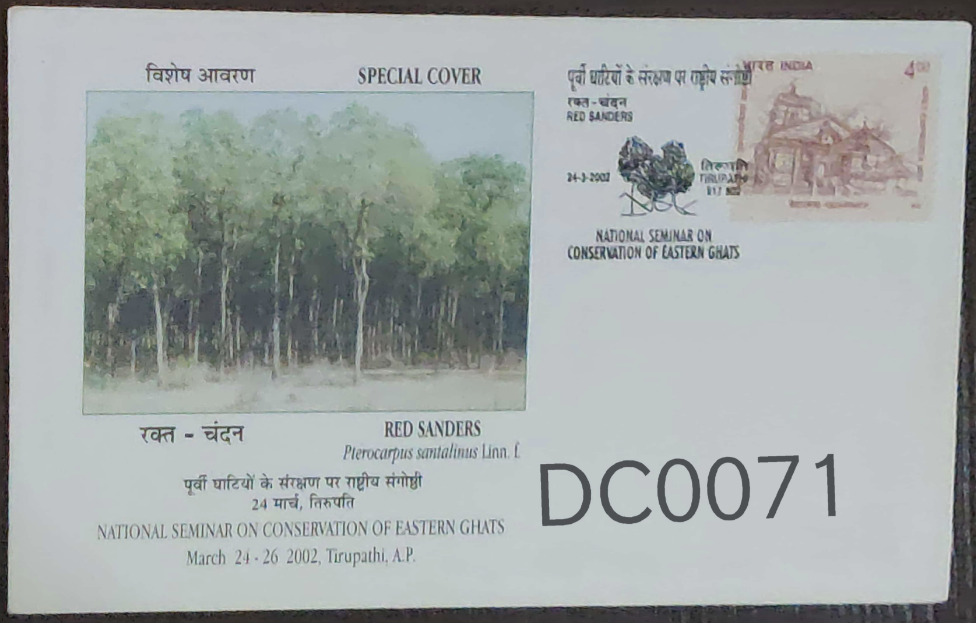
The next seminar conducted by EPTRI was exactly 4 years later, at SV University in Tirupati. The National Seminar on Conservation of Eastern Ghats conducted between 24-26 March 2002, featured 74 abstracts, once again focusing on the Ecology, and Conservation. There were, in addition a number of papers that focused on human livelihood issues as well. Interestingly, a postal cover was issued to mark the event, highlighting the Red Sanders tree, which is prominent in the forests around Tirupati.
The latest (and largest) EPTRI event was organised in Chennai between 28-29 December, 2007. Various parts of the Proceedings from this National Seminar on Conservation of Eastern Ghats, edited by SH Baquer, I Siva Rama Krishna, LM Bakshu, C Sudhakar Reddy are partially available on Research Gate. This event featured 84 presentations, with the majority being on Ecology. Significantly, a large number of remote sensing studies were featured, focusing on landscapes and vegetation.
An analysis of the titles from the EPTRI proceedings reveal that studies on plants typically dominated the meetings, with a strong emphasis on medicinal plants and ethnobotany. This was followed by multi-taxa studies, and studied focused on just fauna were not common. Biodiversity Assessment and Conservation were the top two themes, together accounting for almost half of all research presented. Over the years, studies indicated a growing use of technology, partiicularly remote sensing/GIS. There was also a significant socioeconomic/livelihood dimension presented across years.
Following the EPTRI meetings, several shorter conferences on the Eastern Ghats have organised by organisations like the Council for Green Revolution (CRG), Hyderabad. A list of their meetings can be found on their website. Through their GrACE initiative (Green’s Alliance for Conservation of Eastern Ghats), they organised the Regional Convention at Andhra University, Visakhapatnam (19 November, 2011), Regional Convention at Acharya Nagarjuna University, Guntur (10 March, 2012), National Conference at SRM University, Chennai (30 July, 2012), National Conference at Sri Venkateswara University, Tirupati (December 4-5, 2014), and National Conference at Utkal University, Bhubaneswar (April 16-17, 2016). All of these events culminated in the publication of a comprehensive report - The Eastern Ghats Environment Outlook (https://cgrindia.org/grace/), in October 2019. This report provides in-depth analysis of the region’s environmental status, challenges, and recommendations for sustainable management.
In 2022, the National Biodiveristy Authority and IISER Tirupati organised the Eastern Ghats Symposium 2022 in Tirupati. The meeting was organised during the pandemic, and was a short meeting, with multiple hybrid sessions. This meeting featured over 30 presentations, but the focus shifted to including studies about Evolution and Outreach in addition to Ecology and Conservation. Significantly, there was much more emphasis on animal studies (52% vs ~20% in earlier years) with birds, mammals, and insects being represented. Multiple studies used citizen science approaches. A special session on Red Sanders trees indicated concentrated effort on this endangered species. Several advanced techniques were showcased, including molecular genetics, acoustic monitoring, etc.
This quick summary shows a clear trajectory of research evolution in the Eastern Ghats from 1998 to 2022 - from basic surveys to molecular, genetic, and technology-driven conservation approaches.
Further Reading #
- Chintala, Sudhakar Reddy. (2008). Proceedings of the National Seminar on Conservation of Eastern Ghats.
- GrACE. 2019. Eastern Ghats Environment Outlook, Greens’ Alliance for Conservation of Eastern Ghats, Hyderabad, India.
- Three Day Seminar on Eastern Ghats. Times of India, 25 March 2002.
- Rajamani, N, & Mathur, VB. (2022). Conserving biodiversity of the Eastern Ghats: Challenges and the way forward. Conference Proceedings. Conserving biodiversity of the Eastern Ghats: Challenges and the way forward., Tirupati, Andhra Pradesh, India. Zenodo. https://doi.org/10.5281/zenodo.8054436