Scaled Reptiles from the Northern Eastern Ghats
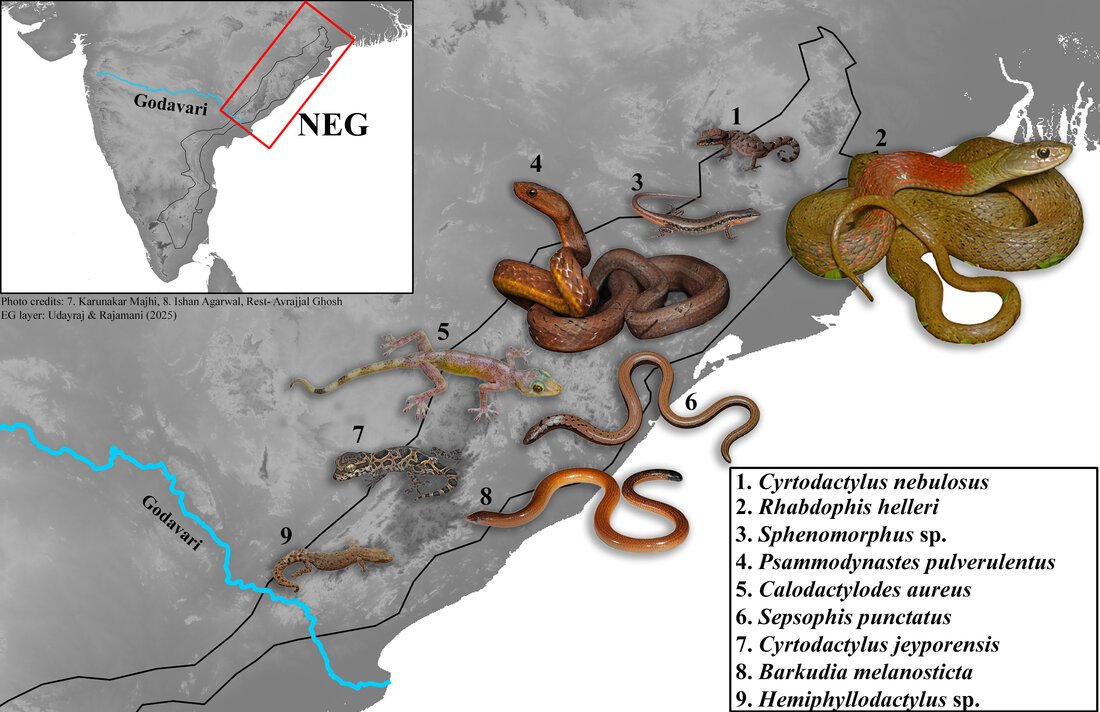
The Eastern Ghats (EG), often overshadowed by their illustrious western counterpart, harbour a surprisingly distinctive and biogeographically intriguing assemblage of squamates (scaled reptiles). From a biogeographic point of view, intuitively, the northern EG [NEG, (north of Godavari Valley)] should derive elements from North-East India (NEI). At the same time, the southern EG (SEG) should have affinities with the southern WG. While this broad pattern generally holds, the NEG reveal a far more complex evolutionary mosaic, of which I discuss a few examples here.
The NEG have its share of Southeast Asian (SEA) elements speculated to have arrived through transoceanic dispersal. Examples include the peninsular Indian Cyrtodactylus (subgenus: Geckoella) and Hemiphyllodactylus geckos. The Cyrtodactylus radiation in the NEG primarily comprises the high-altitude and restricted C. jeyporensis, along with a radiation of cryptic species encompassing the C. nebulosus group. In contrast, Hemiphyllodactylus—tiny, arboreal or rock-dwelling geckos—form a widespread yet cryptic radiation across the EG, WG, and isolated southern Indian hills.
Many SEA and East Asian elements have their westernmost distribution range in NEI. Intriguingly, several NEI elements appear to have extended westward into the NEG. These include a Spenomorphus skink morphologically akin to S. maculatus from NEI and snakes, such as the Mock Viper (Psammodynastes pulverulentus), and the Red-necked Keelback (Rhabdophis helleri).
Adding further complexity, two NEG endemic limbless skink genera—Barkudia and Sepsophis—exhibit unexpected African affinities, suggesting a transoceanic dispersal from sub-Saharan Africa during the Early Eocene (ca. 54–52 Mya). Another puzzling origin story revolves around another endemic— the golden gecko (Calodactylodes aureus). Although its phylogenetic position remains unresolved, several large-scale supermatrix phylogenies have placed it as sister to some African or Malagasy geckos, hinting at either transoceanic dispersal or deep Gondwanan vicariance.
Thus, far from being a biological backwater, the Eastern Ghats stand as a living museum of ancient connections, many of which remain a mystery.
Avrajjal Ghosh is a postdoc at the Department of Zoology at Charles University, Prague, studying distribution patterns of squamates in the North African and West Asian deserts.
Further Reading #
- Agarwal, I., & Karanth, K. P. (2015). A phylogeny of the only ground-dwelling radiation of Cyrtodactylus (Squamata, Gekkonidae): Diversification of Geckoella across peninsular India and Sri Lanka. Molecular Phylogenetics and Evolution, 82 Pt A, 193–199.
- Agarwal, I., Khandekar, A., Giri, V. B., Ramakrishnan, U., & Karanth, K. P. (2019). The hills are alive with geckos! A radiation of a dozen species on sky islands across peninsular India (Squamata: Gekkonidae, Hemiphyllodactylus) with the description of three new species. Organisms Diversity & Evolution, 19, 341–361.
- Datta‐Roy, A., Brandley, M., Austin, C., Bauer, A., Harris, D., Carranza, S., Ukuwela, K.D.B., De Silva, A., Tolley, K.A., Karanth, K.P. & Sil, M. (2024). The Contemporary Distribution of Scincine Lizards Does Not Reflect Their Biogeographic Origin. Journal of Biogeography 52: 767-779.
- Title, P.O. et al. (2024). The macroevolutionary singularity of snakes. Science 383, 918–923
- Tonini, J. F. R., Beard, K. H., Ferreira, R. B., Jetz, W., & Pyron, R. A. (2016). Fully-sampled phylogenies of squamates reveal evolutionary patterns in threat status. Biological Conservation, 204, 23–31.
- Zheng, Y., & Wiens, J. J. (2016). Combining phylogenomic and supermatrix approaches, and a time-calibrated phylogeny for squamate reptiles (lizards and snakes) based on 52 genes and 4162 species. Molecular Phylogenetics and Evolution, 94, 537– 547.