The Easterly Tilt Of The Deccan Plateau
A reader came across an old post of mine on the uplift history of the Western Ghats and asked:
1) What is the relationship between the Deccan volcanics and the easterly tilt of the Indian plateau (i.e. the plateau covering the Deccan volcanics and the southern Indian peninsular region)
2) Why is the northern half of the Western Ghats composed of basalt and the southern half composed of gneiss?
The region south of the Tapi river covering the Deccan basalts and the southern Indian peninsula exhibits an easterly drainage with the rivers flowing into the Bay of Bengal. Image below shows the Indian peninsular region with easterly drainage. The Deccan Plateau (in green) is the area covered by the Deccan basalts. South of this region is Precambrian terrain. Along the east coast there are Permian-Triassic and Cretaceous basins.
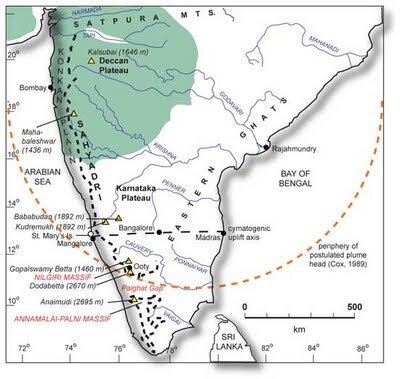

Source: Sheth H.C. (2007)
The relationship between the Deccan volcanics and this easterly tilt is indirect. There are many plausible reasons for the easterly tilt of the Indian crust. ,
a) The breakup of Gondwanaland produced Permian-Triassic rift basins along what is now the eastern margin of India. Initially the sources of sediment being deposited in these basins were from the east and south i.e elevated regions now forming continental shelves of India and the continental margins of Australia and Antarctica. Beginning late Jurassic rifting produced the now western margin of India. This younger rifting event generated topography to the west and reversed sediment distribution patterns. The Late Jurassic and Cretaceous basins of south India received sediments from the west i.e. via an easterly drainage.
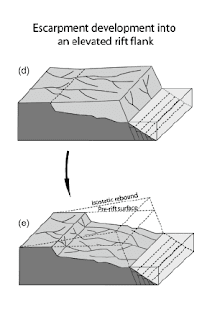
b) The rifting event that created the western margin of India also eventually triggered the Deccan volcanic episode. Post volcanism in the Cenozoic the Deccan region has titled to the east due to the Western margin undergoing uplift. This has been explained as an isostatic response to denudational unloading of the crust i.e. erosion has stripped material away from the Western margin forming the coastal plain and the steep Western Ghat escarpment. All that eroded sediment has been deposited within basins in the Arabian sea. This removal of weight has led to the crust rebounding and tilting in an easterly direction. The schematic shows the development of an easterly tilt ( east to the left) due to rift flank uplift and isostatic rebound (source: Campanile et al 2008)
c) The eastern margin of India is older (about 130 my) than the western margin (about 65 my). The oceanic lithosphere in the Bay of Bengal is colder and denser and it is sinking and dragging down the peninsular region with it.
d) The Bengal sediment fan i.e. the pile of sediment eroded from the Himalayas throughout the Cenozoic and deposited in the Bay of Bengal is weighing the crust down and exerting a dragging down effect on the Indian peninsular region. There is about 22 km of sediment at the mouth of the Ganges -Brahmaputra delta and about 8 km of sediment as south as Chennai.
Likely all the above have acted in combination to produce the easterly tilt.
2) The reason why the southern part of the Western Ghats are made of gneiss is that the Deccan lavas never erupted and flowed that far south. So the boundary between the basalts and the gneiss marks the southern limit of Deccan volcanism.
Reproduced with permission from Suvrat Kher, a sedimentary geologist and of the Rapid Uplift blog. This article was first published here https://suvratk.blogspot.com/2011/09/easterly-tilt-of-deccan-plateau.html on September 11, 2011
Further Reading #
- Hetu C. Sheth. Plume-related regional pre-volcanic uplift in the Deccan Traps: Absence of evidence, evidence of absence
- D. Campanile, C. G. Nambiar, P. Bishop, M. Widdowson, R. Brown. 2007. Sedimentation record in the Konkan–Kerala Basin: implications for the evolution of the Western Ghats and the Western Indian passive margin. Basin ResearchVolume 20, Issue 1 pp. 3-22. First published: 06 December 2007 https://doi.org/10.1111/j.1365-2117.2007.00341.x