Mammal diversity patterns across the Eastern Ghats
The Eastern Ghats landscape, spanning across Odisha, Andhra Pradesh, Telangana, Tamil Nadu, and Karnataka, from 110 03 'to 220 00' N and 760 05' to 860 03' E, is one of the most threatened forest landscapes globally, characterised by relatively high rate of deforestation and forest degradation, with some studies suggesting that 15.83% of forest cover has been lost over the past three decades (Aditya and Ganesh 2017; Ramachandran et al. 2018; Reddy et al. 2009). These mountains range from 20 m at the lowest point in the Godavari River valley to about 1,695 m at the summit of Jindhagada peak, the highest mountain in the Eastern Ghats (Rao and Pullaiah 2007). The Northern Eastern Ghats are the highest section of the ranges, with an average elevation of about 900 masl, although many of the higher summits in the region rise well above 1500 m (Beehler et al. 1986). Several long rivers such as the Godavari (1,465 km), Krishna (1,400 km), Mahanadi, and smaller ones like the Rushikulya, Vamsadhara, Nagavali, Sarada, Thandava, Gundlakamma, Penna, Suvarnamukhi and Palar flow through the Eastern Ghats on their way into the Bay of Bengal, giving the Ghats their characteristic discontinuous nature. The Eastern Ghats is comprised mainly of moist and dry deciduous forests, with patches of semi-evergreen forest and scrub vegetation (Champion & Seth, 1968; Reddy et al., 2010; Goswami et al., 2018).
Mammal diversity in the Eastern Ghats: While mammal occupancy and distribution in India’s priority landscapes like the Western Ghats and Himalayas have been well documented, only a handful of studies have been done on mammals in the Eastern Ghats (Aditya and Ganesh 2016; Balaji and Satyanarayana 2016), and many of these have been focused on the Central and Southern Eastern Ghats region (Srinivasulu 2001; Srinivasulu and Nagulu 2002; Nagulu et al. 2002; Kumara et al. 2009; Sreekar and Srinivasulu 2010; Debata et al. 2019).
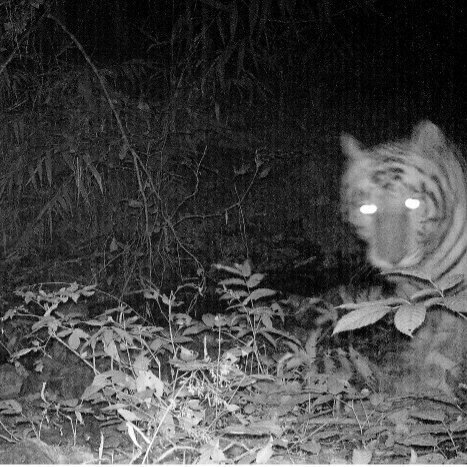
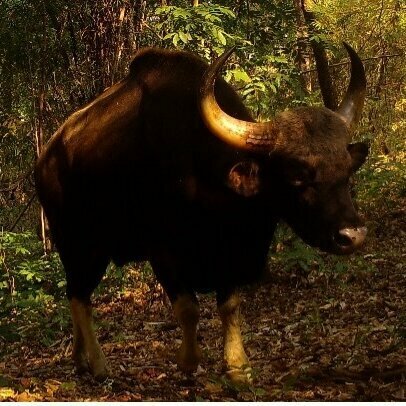
Since 2014, our team has been conducting mammal occupancy surveys using camera traps and sign-based surveys across various habitats and elevation zones in the Northern Eastern Ghats of Andhra Pradesh, with a focus on Papikonda NP and its surrounding areas, and more recently in southern Odisha. Our work shows that the Eastern Ghats contain a diverse assemblage of mammals. We recorded 25 species of mammals from 21 genera in our camera trap surveys (Images 1–21). We reported the first photographic records of species such as the leopard cat Prionailurus bengalensis, the rusty-spotted cat Prionailurus rubiginosus, the stripe-necked Mongoose and the honey badger Mellivora capensis (Aditya and Ganesh 2016; Aditya and Ganesh 2017; Aditya & Ganesh 2020) (Figure 1). Through interviews with forest-dwelling communities, we identified an additional 35 species of mammals occurring in the region, bringing the total to 57 species of mammals belonging to 24 families in the Northern Eastern Ghats. These included 14 species of carnivores, 13 species of bats, and 11 species of rodents. Several large and threatened mammal species, such as the tiger Panthera tigris, leopard Panthera pardus, sloth bear Melursus ursinus, wolf Canis lupus pallipes, jackal Canis aureus, wild dog Cuon alpinus, leopard cat Prionailurus benghalensis, rusty spotted cat Prionailurus rubiginosus, honey badger Mellivora capensis, gaur Bos gaurus, Nilgai Boselaphus tragocamelus, four-horned antelope Tetraceros quadricornis, sambhar Rusa unicolor, chital Axis axis, and the barking deer Muntiacus muntjac, occur across the region (Aditya and Ganesh 2017). Overall, we found that mammal species richness in the Northern Eastern Ghats was highest in dry deciduous forests (18) followed by moist deciduous forests (14). However, DDF were dominated mainly by generalist species, such as barking deer, four-horned antelope, and chital, whereas MDF supported species that preferred denser vegetation and higher elevations, such as gaur, sambar, tiger and Indian pangolin. Elevation and vegetation density had the most significant influence on mammal abundance. In our surveys, we found that herbivorous species, including the Indian muntjac, four-horned antelope, and wild pig, exhibited crepuscular activity patterns, peaking during early mornings and late evenings. However, species like the gaur and sambar were more active at night and early mornings. Carnivorous species, including the small Indian civet, leopard cat, and jungle cat, were primarily active at night and during early mornings. Rhesus macaque and grey langur were mostly diurnal. Herbivorous species had wider activity periods but sharper temporal activity peaks. There was significant overlap between human and herbivore activity patterns (Aditya and Ganesh 2022), and this overlap could favour hunting of herbivores. Human activity in forests, in particular, high hunting pressure, could therefore be a potential threat that also influences the temporal behaviour of mammals.
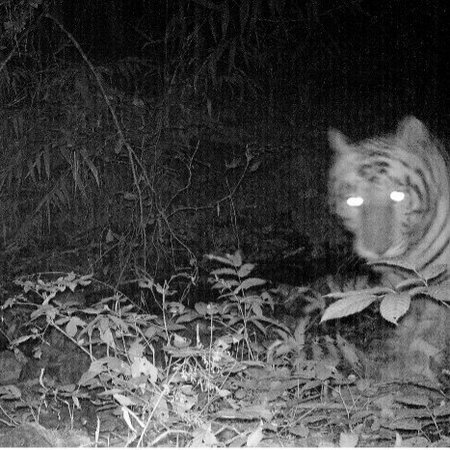
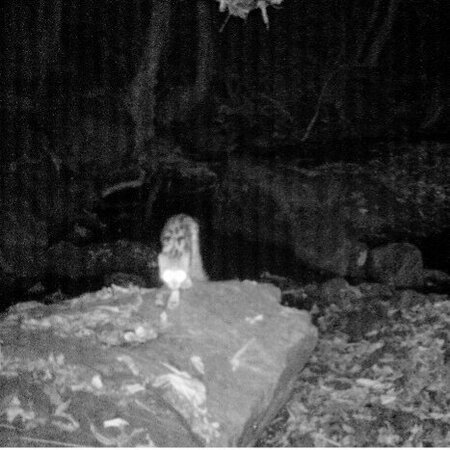
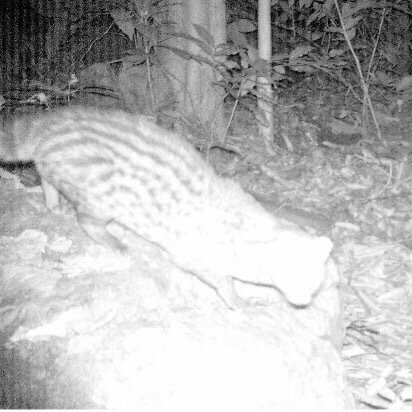
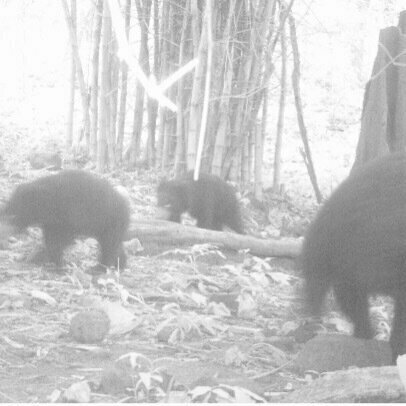
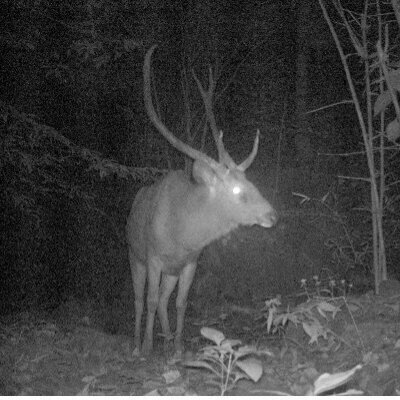
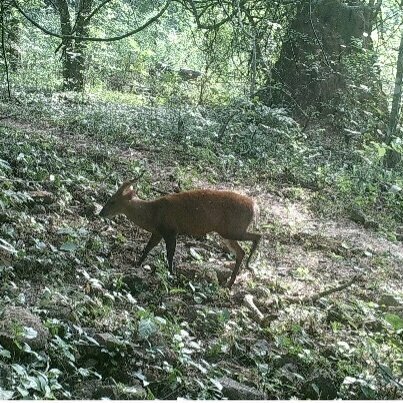
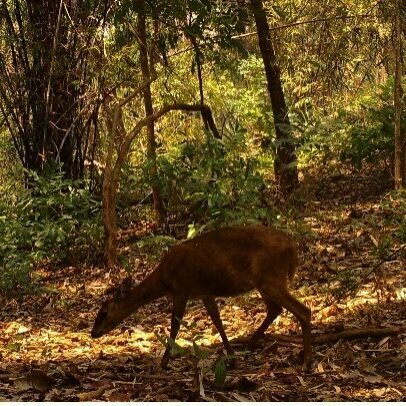
More recently, we conducted surveys on the impacts of roads and vehicular traffic on mammal occupancy and abundance patterns in the Central Eastern Ghats region, focusing on the Nagarjunasagar-Srisailam Tiger Reserve (18°29'31"N–19°10'53" N and 79°32'28"–83°14'0" E; Figure 1), India’s largest tiger reserve spread over 3,728 km2 in the Nallamala ranges. The central Eastern Ghats are considerably lower than the Northern EG, with elevations ranging between 20 and 850 m asl, and are dominated by dry thorn and dry deciduous vegetation. We conducted camera trap surveys in NSTR to assess the impacts of vehicular traffic on the NH 765 Doranala–Srisailam highway, setting 54 camera traps on and away from the highway, one at every kilometre. We detected a total of 16 species of mammals during the study, comprising 2,616 detections across 795 camera trap nights. Several large and threatened mammal species, listed as Endangered, Vulnerable, or Near Threatened, were found along the NH. Our study found that herbivores were relatively tolerant of roads with high vehicular traffic, but carnivores largely avoided them (Aditya et al. 2025). The expansion and construction of new roads could therefore have a significant negative impact on mammals, particularly affecting carnivores.
Threats to mammals: Podu shifting cultivation, infrastructure development, particularly road and dam building, mining and plantations, are causing rapid deforestation and land cover changes in the Eastern Ghats, and this habitat loss is adversely affecting wildlife populations. Additionally, the total protected area coverage of the Eastern Ghats is only 9,767.64 km², representing 6.3% of the landscape, which is far lower than that of the Western Ghats or Himalayan landscapes (WDPA 2011). This percentage is even lower in the Northern Eastern Ghats of Andhra Pradesh, where only 3.53% of the total area is protected. Widespread hunting is one of the most significant threats to mammals across the Eastern Ghats (Aditya et al., 2022; Ganesh et al., 2015). In the Northern Eastern Ghats, local community members interviewed in our study reported 12 species of mammals that were commonly hunted for various purposes, mainly opportunistically for food, as a traditional form of recreation, and occasionally for wildlife trade. Mammals such as pangolins, barking deer, four-horned antelope, wild boar, black naped hare, gaur, spotted deer, sambar, langur, giant squirrel, mouse deer and civets were reported to be hunted (Aditya et al. 2022). Hunting is mainly done with bows and arrows, snares, traps and nets, catapults and use of poison. Dogs play a significant role in hunting in the region. The high hunting pressure, combined with rapid land cover changes are probably responsible for the relatively lower mammal abundance across the landscape (Aditya and Ganesh 2022; Aditya et al. 2021; Ganesh et al. 2015). Multiple human uses of forests in landscapes with low protection levels, like the Eastern Ghats, could therefore strongly impact mammal occurrence, diversity and activity patterns. However, community engagement in conservation, coupled with landscape restoration and reforestation, can help recover habitats for wildlife across the Eastern Ghats.